A painting lost for six decades:
the Rijksmuseum confirms it is a Rembrandt.  Automatic translate
Researchers at the Amsterdam Rijksmuseum officially confirmed that the 1633 painting "The Vision of Zechariah in the Temple" was painted by Rembrandt van Rijn. The announcement was made on March 2, 2026, and on March 4, the painting was unveiled to the public for the first time in 65 years.
What is depicted in the painting?
The story begins in the first chapter of the Gospel of Luke. The high priest Zechariah stands in the Temple in Jerusalem when the Archangel Gabriel appears to him with unexpected news: despite his advanced age, he and his wife Elizabeth will have a son — John, the future Baptist.
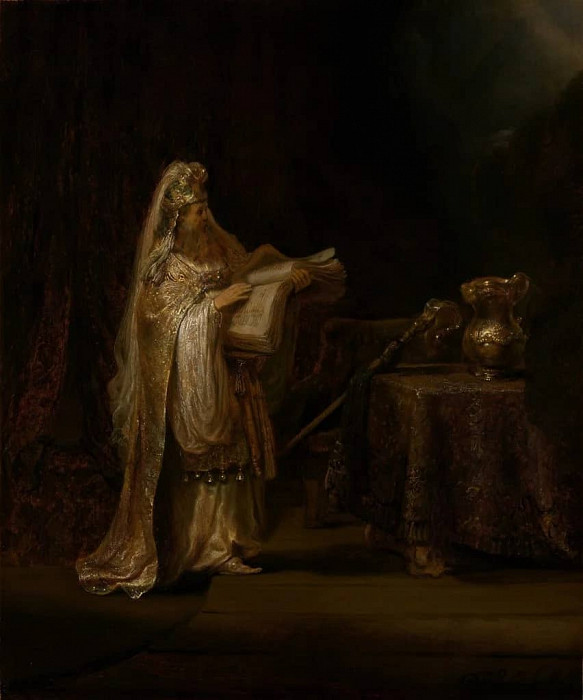
The angel himself is not depicted in the painting. The artist indicated his presence only by a stream of light emanating from the upper right corner. Zechariah’s face expresses confusion — exactly how the Gospel describes him. This technique, conveying the supernatural through lighting rather than direct depiction, is typical of Rembrandt’s biblical works of this period.
The painting is based on an oak board. Wood as a medium was the norm for Netherlandish painters of the first half of the 17th century: before canvas became widespread, wood panels were used for small and medium-sized works. The painting is signed and dated "1633."
From public display to private collection
In 1898, the painting was exhibited at Rembrandt’s first major retrospective at the Stedelijk Museum in Amsterdam. Its authorship was beyond doubt, and the work was perceived as a documented work by the master.
In 1960, experts revised this assessment. Researchers concluded that the painting was most likely created not by Rembrandt himself, but by someone in his inner circle. According to the Dutch publication Het Parool, two possible artists were mentioned: Jan Lievens and Salomon Koninck. Both worked in a similar style, both painted dramatic biblical scenes with contrasting lighting, and both were close enough to Rembrandt that their early works were often confused with his own.
A year later, in 1961, the painting was purchased by a private collector. The canvas disappeared from public view and remained invisible to specialists and the public for over half a century. Because no researchers were able to examine the original, the 1960 attribution was never reconsidered — simply because there was no basis for reconsideration.
An anonymous collector and his solution
About two years ago, the painting’s current owner contacted the Rijksmuseum with a request for research. According to Reuters, this man received the painting from his father, who acquired it in 1961. The collector’s identity has not been disclosed.
The museum accepted the painting into its Conservation and Science Department, one of the most technically advanced units of its kind in the world. It was this department that, for several years, led "Operation Night Watch" — a multi-year project to study and restore "The Night Watch" of 1642. The methods developed for this project were also applied to "The Vision of Zechariah."
Two years of research
The work lasted approximately two years. Experts combined traditional stylistic analysis with modern physical and chemical diagnostics.
The painting was compared to other works by Rembrandt from the early 1630s. Among the closest analogies are "Daniel and Cyrus Before the Idol Bel" (1633, Getty Museum, Los Angeles), "The Song of Simeon" (1631, Mauritshuis, The Hague), and "Jeremiah Lamenting the Destruction of Jerusalem" (1630, Rijksmuseum). The stylistic similarities were obvious: the same use of light, the same expressive poses, a similar way of constructing space within the frame.
At the same time, the signature was examined. Rembrandt’s signature style changed with age and can be dated — material on this topic has been accumulated over years of work on "The Night Watch" and other confirmed works. The signature on "The Vision of Zechariah" was deemed authentic.
What is Macro XRF and Why is it Important?
The central research tool was macro-X-ray fluorescence imaging, a method abbreviated as MA-XRF. An X-ray beam scans the painting’s surface line by line, exciting the atoms of chemical elements in each pigment. Each element — lead, copper, mercury, iron — responds to this irradiation with its own characteristic fluorescent signal. A detector records these signals, resulting in maps of the distribution of the elements across the entire surface of the work, layer by layer, without touching the paint.
This allows us to do several things at once. First, to compare the pigment composition with other documented works by the same artist and from the same period. Second, to identify traces of edits hidden beneath the final paint layer. It was precisely these traces — pentimenti — that were discovered during scanning of "The Vision of Zechariah": the artist repositioned individual figures and adjusted contours while still working on the painting. Such changes during the process are typical of 17th-century Netherlandish masters and are well known from other works by Rembrandt.
The tree doesn’t lie: dendrochronology
The oak board underwent separate analysis. Dendrochronology — a method of dating wood using tree rings — allows us to determine the time when the tree was felled. Each year, the tree adds one ring; the ring width depends on the climate of the specific growing season. Since ring patterns are unique to each region and period, a section of the board can be compared to reference chronologies to obtain a precise date.
Analysis revealed that the tree was felled approximately between 1625 and 1640, which is entirely consistent with 1633 as the painting’s date of creation. No contradictions were found.
Rembrandt in 1633: Biographical Context
Rembrandt van Rijn was born in 1606 in Leiden, then the second-largest city in the Netherlands, with a university, textile industry, and a vibrant merchant community. He learned the basics of painting from the local master Jacob van Swanenburgh, and then spent several months in Amsterdam with Pieter Lastman, an artist who specialized in dramatic historical and biblical scenes with expressive characters. Rembrandt deeply absorbed Lastman’s lessons in working with space and gesture.
Returning to Leiden around 1625, Rembrandt began working independently. At his side during this period was Jan Lievens, a contemporary of his, who was producing works of a similar nature. Their styles were so intertwined in the late 1620s that Constantijn Huygens, secretary to the Prince of Orange and an influential art connoisseur, described them both in 1629 as virtually equal in talent. This mutual influence later became the source of attribution difficulties.
Around 1631, Rembrandt moved to Amsterdam. There, he entered into a business partnership with the art dealer Hendrick Uylenburch, gained access to wealthy clients, and began actively working as a portrait painter. Amsterdam, at the time a major port and financial center in Europe, opened up a whole new range of opportunities for Rembrandt. By 1633, when he was 27, he was already painting portraits of wealthy citizens while simultaneously developing his own style on biblical themes.
Rijksmuseum Director Taco Dibbits commented on the discovery: “It’s wonderful that people will now be able to learn more about the young Rembrandt — he created this deeply moving work shortly after moving from Leiden to Amsterdam. It’s a wonderful example of Rembrandt’s unique way of telling stories.”
Lievens, Koninck and the problem of attribution
When experts questioned the authorship in 1960, they named two possible authors: Jan Lievens and Salomon Koninck.
Jan Lievens (1607–1674) worked closely with Rembrandt during his Leiden period. Their influence on each other was profound and mutual. After Lievens left for London in the early 1630s and then moved to Antwerp, his style changed, but his early works remain challenging to attribute.
Salomon Koninck (1609–1656) worked in Amsterdam in the spirit of Rembrandtism: contrasting lighting, dark backgrounds, dramatic biblical and mythological scenes. He did not study Rembrandt directly, but clearly drew inspiration from his works. For researchers in the 1960s, who had neither access to the original nor physical diagnostic technology, choosing between the three was virtually impossible.
MA-XRF and dendrochronology largely eliminate this uncertainty. The chemical composition of pigments and the structure of the wood substrate provide objective, verifiable data — data that stylistic assumptions cannot compete with.
Operation Night Watch: Where the Methodology Came From
The current research would not have been possible without the experience gained during many years of work with the Night Watch.
"The Night Watch" (1642), a group portrait of an Amsterdam rifle company measuring approximately 363 x 437 centimeters, has been housed at the Rijksmuseum since 1808 and is considered one of the most studied paintings in the world. "Operation Night Watch" brought together dozens of specialists — conservators, chemists, physicists, and art historians. The painting was studied in a specially constructed box right in the museum hall, and visitors were able to observe this work in person.
Over the course of the project, the Rijksmuseum team developed a full-surface MA-XRF imaging technique, compiled a reference database of Rembrandt’s pigments by period, and developed criteria for comparative paint layer analysis. This database became the primary reference tool in the study of "The Vision of Zechariah." Essentially, the years of work on "The Night Watch" created an infrastructure without which the current authentication would have been significantly more difficult.
When authorship changes price
Attributing a work of art is both a scientific and an economic matter. In 2021, Christie’s Amsterdam auctioned "The Adoration of the Magi" (c. 1628). At the time, it was labeled as "Rembrandt’s Circle" — meaning attributed to his workshop or close followers — and sold for just under a million dollars.
In 2023, when experts confirmed the direct authorship of Rembrandt, the same painting sold at Sotheby’s for £10.9 million, or approximately $13.7 million. A difference of more than tenfold. This example clearly demonstrates how a single conclusion about authorship can overturn a market valuation.
"The Vision of Zechariah in the Temple" is on long-term loan to the Rijksmuseum. There is no information about a planned sale.
Public screening and appearance in Burlington Magazine
Since March 4, 2026, "The Vision of Zechariah in the Temple" has been on display at the Rijksmuseum. This is the painting’s first public showing since 1961, after 65 years in private collections.
A full scientific description of the two-year study was published in the March issue of The Burlington Magazine, a British art history journal founded in 1903. The publication specializes in the attribution and study of works of art, and its publication means that the Rijksmuseum researchers’ findings have undergone independent academic peer review.
The painting is displayed alongside other works by Rembrandt from his early Amsterdam period. It was through comparison with these works that the authorship was established — the circle was complete.
- Stockholm National Museum acquires Jan Leavens’ masterpiece
- Key works of Renoir and Leavens sold at TEFAF
- The exhibition of works from the Leiden collection broke the attendance record
- Rembrandt’s "fake" was created in his workshop - perhaps it is the original
- Modular paintings as a form of art
- “Copenhagen” by Michael Frayn
You cannot comment Why?