Admission township heads Emperor Alexander III in the courtyard of Petrovsky Palace in Moscow Ilya Repin (1844-1930)
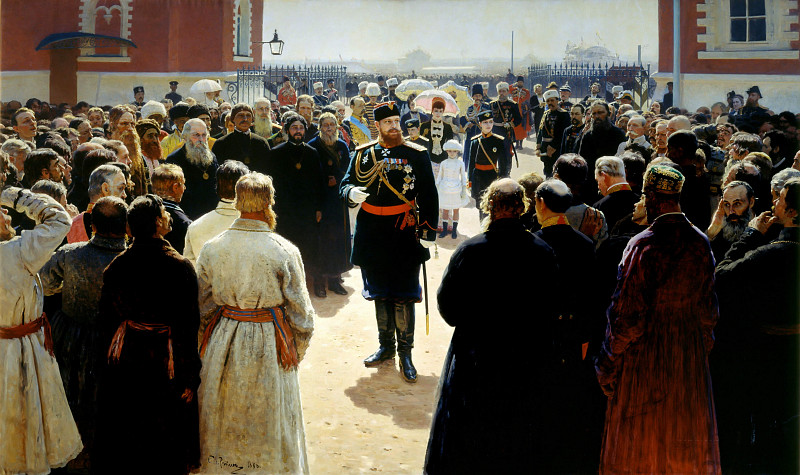
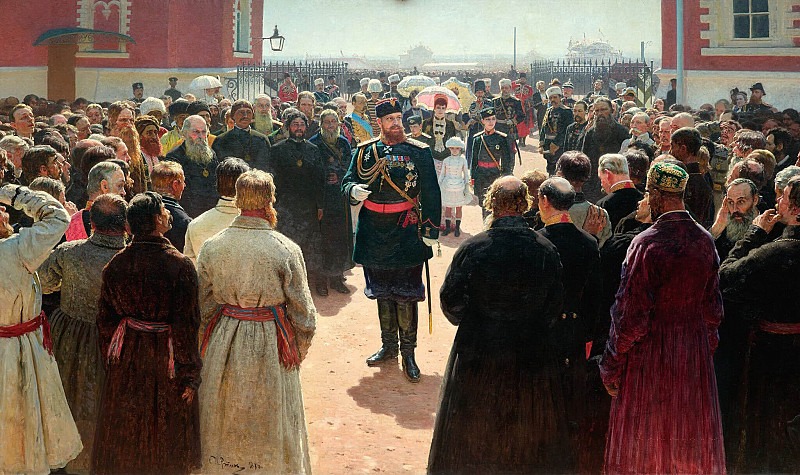

Ilya Repin – Admission township heads Emperor Alexander III in the courtyard of Petrovsky Palace in Moscow
1885-86. 293×490
Edit attribution
Download full size: 4200×2492 px (0,8 Mb)
Painter: Ilya Repin
Location: The State Tretyakov Gallery, Moscow (Государственная Третьяковская галерея).
Album navigation:


COMMENTS: 2 Ответы
Кемска волость, Кемска волость...
Сочинение по картине:
Картина Ильи Репина “Приём волостных старшин Александром III во дворе Петровского дворца в Москве” была написана в 1883 году и с тех пор стала одной из самых знаменитых работ художника. Это произведение представляет собой яркий образец русской живописи XIX века, где художник использовал свойственные ему элементы реализма для создания образа легендарного героя Александра III.
На картине изображен Александр III, император Российской империи, принимающий волостных старшин во дворе своего дворца в Москве. Волостные старшины – это представители крестьянских общин, которые прибыли в Москву для того, чтобы выразить свое уважение императору и просить его помощи и защиты.
Александр III был известен своими реформами, направленными на укрепление государственной власти и улучшение жизни простых людей. Прием волостных старшин стал важным событием в истории России, так как он символизировал признание заслуг крестьянства и его вклада в развитие страны.
Картина “Приём волостных старшин Александром III во дворе Петровского дворца в Москве” стала образцом для многих других произведений художника, таких как “Запорожцы пишут письмо турецкому султану”, “Иван Грозный и сын его Иван” и многие другие.
You cannot comment Why?
The focal point is undoubtedly the man in military attire standing centrally within the crowd. He is positioned slightly forward and elevated relative to those around him, emphasizing his authority. His posture is erect, conveying an air of solemnity and command. The meticulous detail given to his uniform – the medals, the precise arrangement of buttons – underscores his status as a personage of considerable importance. A woman in white stands near him, likely part of the imperial entourage.
The crowd itself is diverse, exhibiting a range of ages, social classes, and apparent ethnicities. Individuals dressed in traditional garb – long coats with elaborate details – are clustered on the right side, suggesting representatives from rural areas or perhaps specific regional groups. Their expressions are largely subdued, marked by respect and anticipation. The men closest to the central figure display an almost reverential gaze.
The architecture of the palace forms a backdrop, its classical lines and symmetrical design reinforcing the sense of order and imperial grandeur. The windows on the upper level offer glimpses into the interior, hinting at the opulence within. A wrought-iron fence separates the courtyard from what appears to be a wider urban space beyond.
Subtleties in the composition suggest underlying themes of power and social structure. The darkness that envelops much of the scene creates a visual barrier between the central figure and the periphery, reinforcing his isolation and authority. The varying degrees of illumination highlight the distinctions within the crowd – those closest to the imperial presence are bathed in light, while others remain shrouded in shadow.
The painting seems to document an official reception or ceremony, likely intended to portray the ruler’s connection with his subjects. However, the sheer scale of the gathering and the palpable tension in the air also suggest a carefully orchestrated display of power – a demonstration of imperial control over a vast and diverse population. The artist has captured not only a moment in time but also a complex interplay of social dynamics and political symbolism.