Rinaldo and Armida Giovanni Battista Tiepolo (1696-1770)
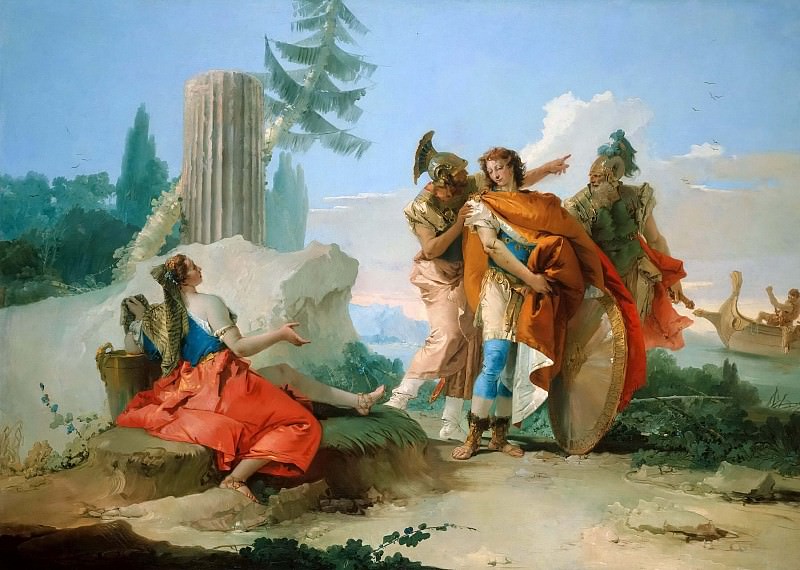
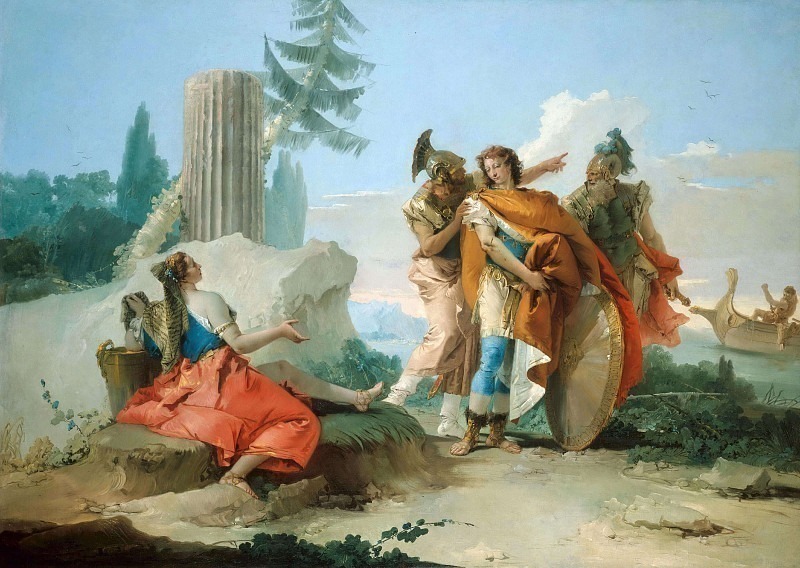

Giovanni Battista Tiepolo – Rinaldo and Armida
1742-45
Edit attribution
Download full size: 3000×2137 px (0,7 Mb)
Painter: Giovanni Battista Tiepolo
Location: Art Institute, Chicago.
Album navigation:


![Giovanni Battista Tiepolo - Virgin and Child [Workshop]](http://cdn.gallerix.asia/j/W/1608114206/2609.webp)


You cannot comment Why?
The three male figures are arranged in a dynamic cluster. The central figure, seemingly the focal point, points emphatically forward, his expression conveying urgency and direction. He is draped in a rich orange cloak that draws the eye. Flanking him are two other men, one bearing a helmet adorned with plumes and holding a shield emblazoned with an emblem; the second similarly equipped, but positioned slightly behind and to the side, suggesting a supporting role or perhaps hesitation. Their armor and weaponry clearly identify them as warriors engaged in conflict.
Behind this group, partially obscured by foliage and architectural ruins, is what appears to be a ship with figures aboard, further reinforcing the notion of travel and potential rescue or pursuit. The remnants of a classical column rise prominently behind the seated woman, adding an air of antiquity and grandeur to the setting. This ruin serves as a visual anchor, grounding the narrative within a historical context while simultaneously suggesting decay and loss.
The color palette is dominated by warm tones – reds, oranges, and golds – which contribute to the overall sense of drama and intensity. The sky, rendered in soft blues and whites, provides a contrasting backdrop that emphasizes the figures below. Light falls unevenly across the scene, highlighting certain areas while leaving others in shadow, creating depth and visual interest.
Subtleties within the painting suggest a complex interplay of power, vulnerability, and persuasion. The woman’s position – both exposed and seemingly powerless – implies a precarious situation. The mens gestures and expressions convey a sense of urgency and determination, but also perhaps uncertainty or internal conflict. The presence of the ship hints at an external force influencing the events depicted, suggesting that deliverance or further entanglement is imminent. Overall, the work explores themes of captivity, negotiation, and the complexities of human interaction within a context of warfare and classical mythology.