Rinaldo and Armida in the Garden Giovanni Battista Tiepolo (1696-1770)
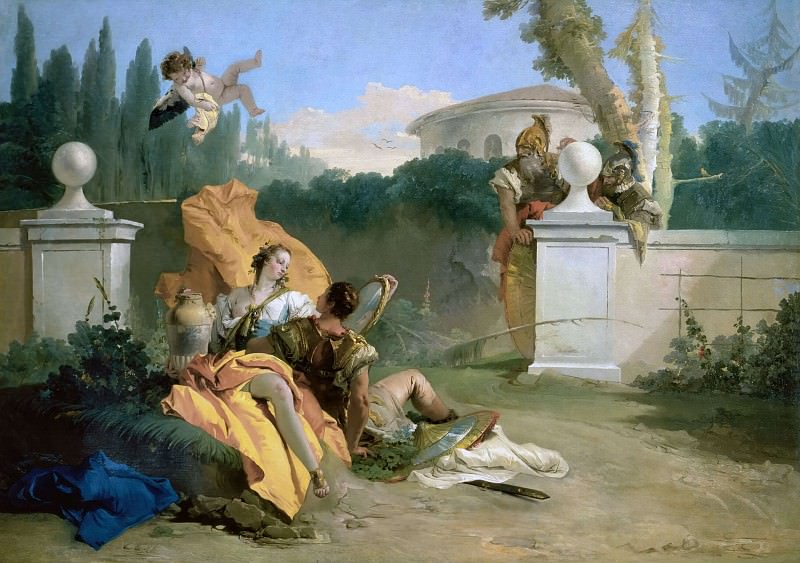
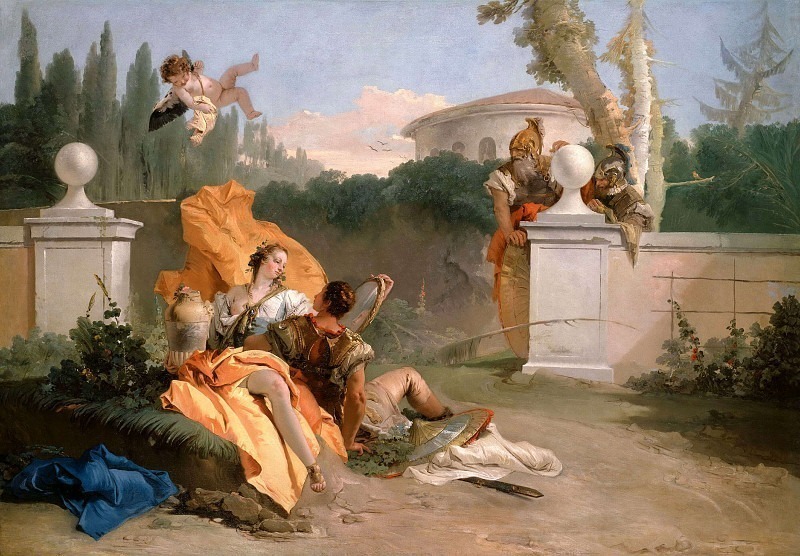

Giovanni Battista Tiepolo – Rinaldo and Armida in the Garden
1742-45. 186.8 x 259.9
Edit attribution
Download full size: 4224×2971 px (1,4 Mb)
Painter: Giovanni Battista Tiepolo
Location: Art Institute, Chicago.
Album navigation:


![Giovanni Battista Tiepolo - The Circumcision of the Children of Israel [Studio]](http://cdn.gallerix.asia/j/T/1001685885/8105.webp)


You cannot comment Why?
The woman’s expression is complex – a mixture of tenderness, perhaps pity, and something akin to melancholy. She holds what appears to be a musical instrument, possibly a lyre or harp, which she seems to be tuning or playing softly. This detail introduces an element of serenity and artistic creation into the scene, contrasting with the implied violence suggested by the discarded weaponry.
To the right, two figures stand within a walled enclosure. They are armored warriors, their faces grim and resolute. Their posture suggests vigilance and impending action; they appear to be observing the reclining pair with a sense of duty or concern. The architectural backdrop – a classical building partially visible through the foliage – reinforces the setting’s artificiality and controlled nature.
Above the central group, an airborne putto (cherub) flits across the sky, scattering what appears to be flower petals. This figure injects a note of lightness and ethereal beauty into the composition, acting as a visual counterpoint to the more grounded drama unfolding below. The overall color palette is warm and muted, dominated by yellows, greens, and browns, which contribute to the scene’s dreamlike quality.
Subtly, the painting explores themes of captivity, temptation, and the conflict between duty and desire. The mans vulnerability and the womans apparent power over him suggest a dynamic of enchantment or imprisonment. The warriors represent an external force, potentially representing reason, honor, or a return to responsibility. The garden itself functions as a symbolic space – a place of beauty and pleasure that also serves as a prison for those within it. The putto’s presence introduces the possibility of divine intervention or a fleeting moment of grace amidst the unfolding drama.