Why Learn English Today:
A Fundamental Analysis of Career and Personal Prospects  Automatic translate
In today’s world, the question "Why learn English?" is no longer rhetorical. For adults, it’s a pragmatic question of investing time and resources. We’ve prepared a detailed analysis based on market statistics, neurophysiology, and our experience teaching thousands of students.
Briefly about the main thing (TL;DR):
-
Income: Access to the global labor market increases the salary ceiling by 2-5 times.
-
Health: Learning languages physically changes the structure of the brain and delays aging.
-
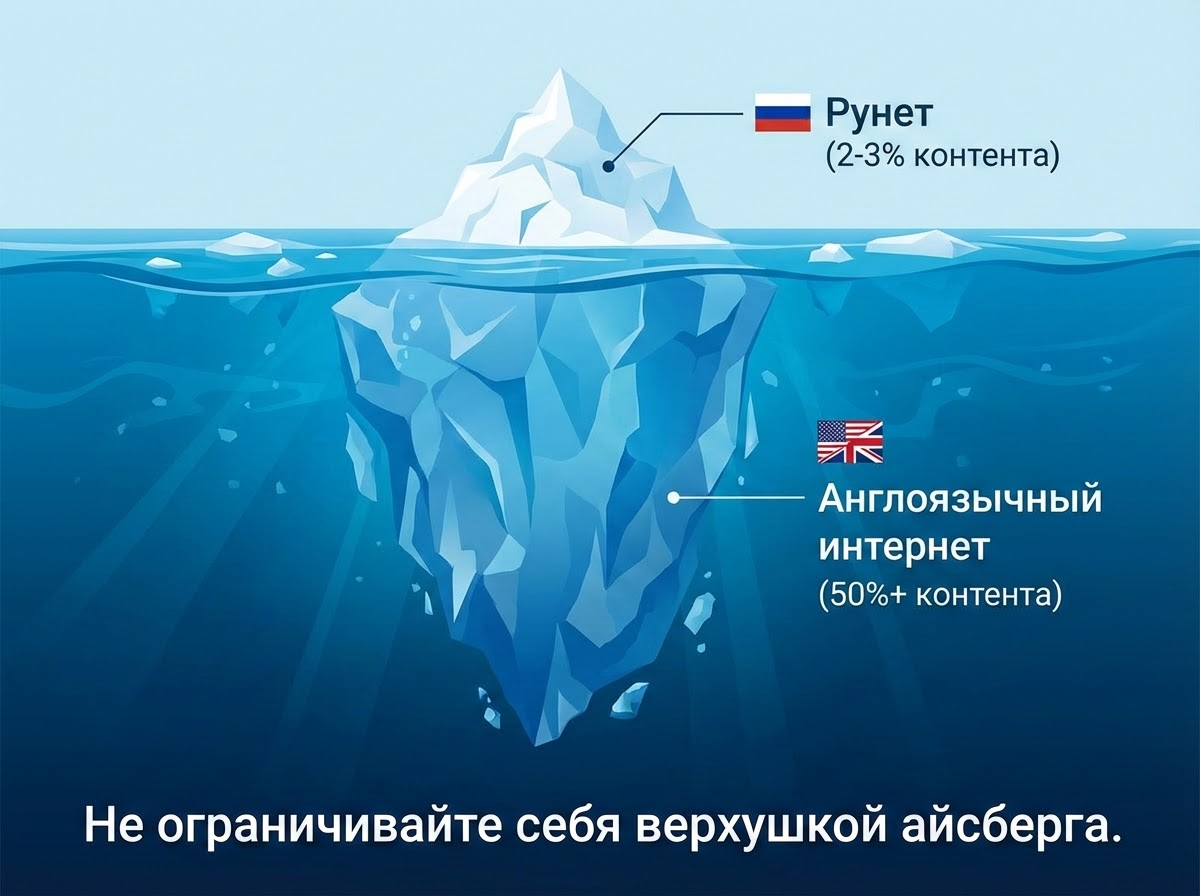
Freedom: You gain access to 55% of the world’s internet and primary sources of knowledge.
-
Method: Rote memorization doesn’t work. Spaced repetition and microlearning are effective.
The visual metaphor below demonstrates the fundamental difference between local and global labor markets. It’s a reflection of your potential scale.

2 Part II. Access to knowledge and quality of life
3 Part III: Brain Health and Removing Barriers
4 Part IV. How to Teach Effectively: Methods and Tools
5 Part V. Roadmap: Your First 3 Months
6 FAQ: Answers to Frequently Asked Questions
7 Conclusion: Your Next Step
Part I. Economics and Career: English as the Highest-Revenue Asset
Let’s turn to the language of numbers. Knowledge of English is an investment tool with a proven ROI (return on investment). Proficiency in the language places a specialist in the Global Talent category, opening access to international budgets. Data analysis reveals a significant income gap between specialists working exclusively for the domestic market and those with access to foreign currency contracts. 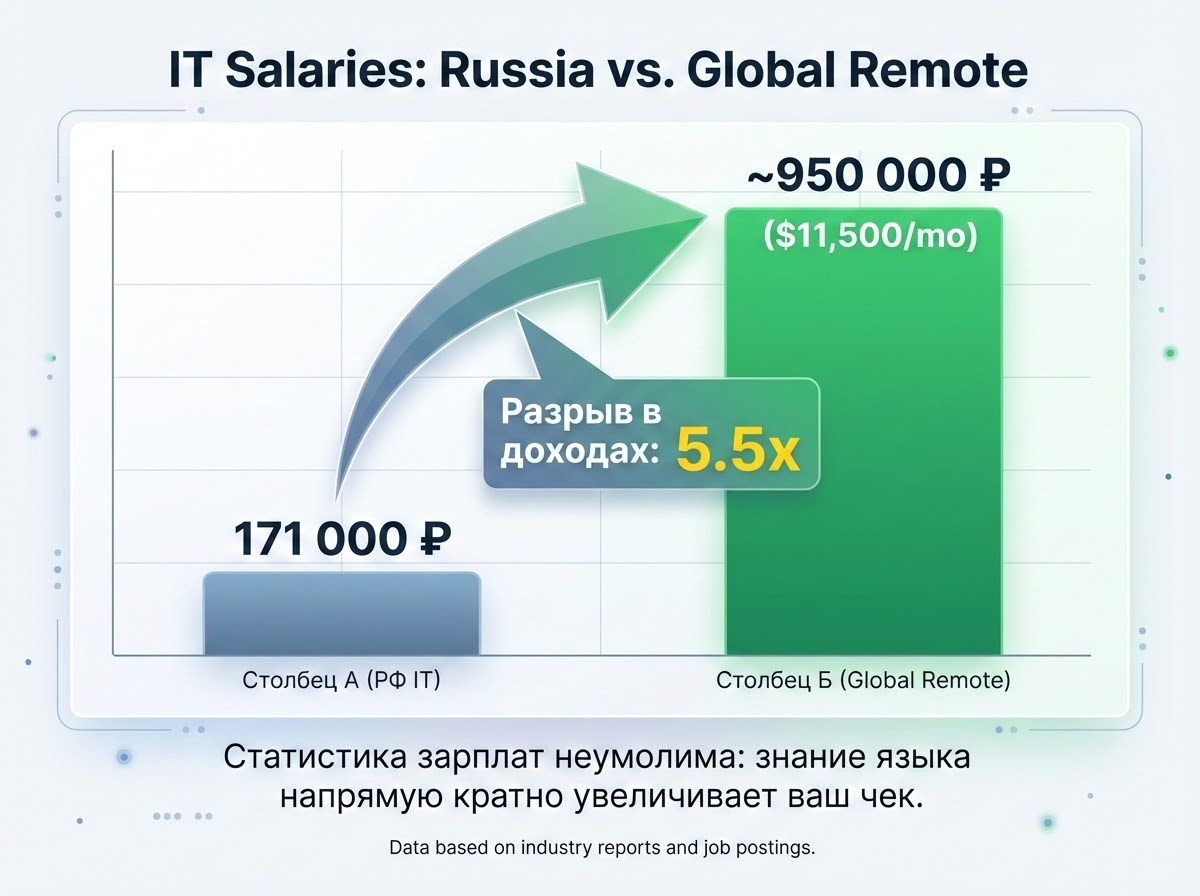
Access to job openings at global giants and remote work
International companies don’t consider resumes without English — it’s a basic hygiene requirement. However, even if you don’t aim to work for a company like Google or Amazon, working remotely for startups in Europe or the US allows you to earn a salary in hard currency while continuing to live in a region with a comfortable cost of living.
**Loss of Profit Calculator: Let’s look at market facts relevant for 2024-2025:
-
The average salary in the IT sector in Russia ranges from 171,164 rubles (regions) to 230,000 rubles (Moscow)
. -
For a similar position in the international market (Remote), the average salary can reach $115,000 per year (USA) or €70,000 (Europe) .
-
The difference between these amounts is a kind of “tax” that a specialist pays for their lack of language skills.
Legal literacy and working with contracts
Entering the international market requires not only conversational skills but also the ability to understand complex documentation. Working with US counterparties, for example, requires understanding IRS tax forms.
To take advantage of the Foreign Earned Income Exclusion (FEIE) and legally optimize your taxes (excluding up to $132,900 from your taxable income under the 2026 limits), you must strictly adhere to the 183-day stay rule and correctly complete forms such as Form 2555.
Without confident English, the risk of making a mistake that could lead to financial losses is critically high.
Competitive advantage in the local market
Even if you plan to remain in Russia, candidates with English language skills always have priority. This opens up opportunities for networking with international partners and business trips. English is no longer just a technical skill (hard skill) – it’s now a mandatory soft skill for any senior manager.
Part II. Access to knowledge and quality of life
The harsh truth is that most of the world’s information is created in English. Professional literature can take years to be translated, and in some cases, translations never appear at all.
-
Access to original sources: Coursera, edX, MIT and Stanford lectures are available in the original here and now.
-
Scientific relevance: Articles in leading journals like Nature and Science are published in English. In high-tech industries such as pharmaceuticals or IT, the delay in receiving information can be critical months. In the context of FDA procedures, this often leads to missed deadlines and losses.
Reading in the original allows you to implement trends before your competitors.
Take a look at the infographic below — it visualizes the amount of information you’re missing out on by limiting yourself to the Russian-language segment of the internet.
Original Content: Why You Can’t Watch Dubbed Movies Anymore
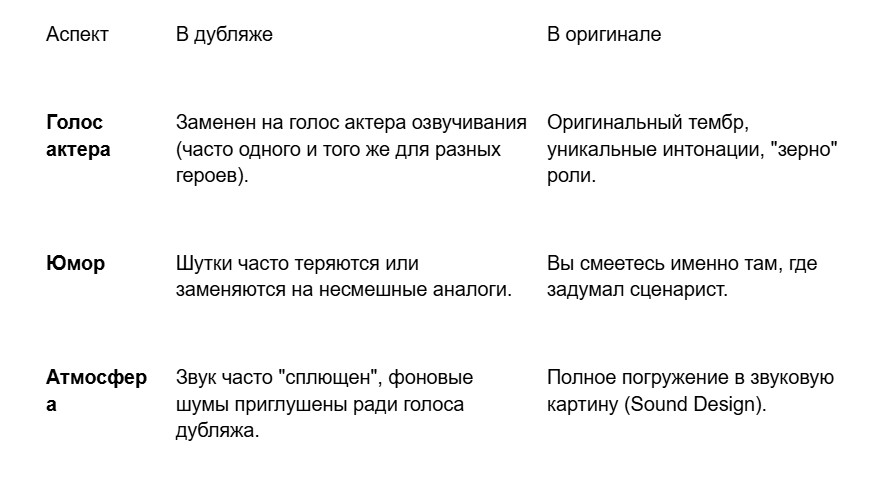
Any translation is an inevitable interpretation. Localizing audiovisual content often leads to the loss of semantic nuances, cultural codes, and the actors’ original intonation.

Comparison of content perception:
Part III: Brain Health and Removing Barriers
English as a "gym" for neurons
Learning a foreign language is a powerful cognitive workout. It triggers neurogenesis (the formation of new neurons) and improves executive functions such as planning, multitasking, and focus.

Scientific evidence confirms the direct impact of bilingualism on health:
-
Matter density: Increased gray matter density in areas responsible for memory.
-
Fighting dementia: Alzheimer’s disease symptoms delayed by an average of 4.05 years, according to a meta-analysis of clinical trials
-
It is more effective than many drug therapies.
Why school has discouraged people from learning, and why things will be different now.
Many adults face a psychological barrier known in science as the Language Ego. It’s psychologically difficult for an adult, an established professional, to feel vulnerable and make the mistakes common to beginners.
Let’s look at the main fears:
-
"I have no talent for languages." This is a cognitive distortion. Language aptitude is an innate function of the brain. If you speak Russian, you can learn English. The problem often lies not in a lack of talent, but in outdated school methods.
-
"I’m afraid of speaking incorrectly." Perfectionism is the main obstacle to progress. Research shows that the fear of forgetting a word (vocabulary retrieval) blocks speech. It’s important to remember: a communicative task is accomplished when the other person understands you. Grammatical perfection is secondary.
- .
Part IV. How to Teach Effectively: Methods and Tools
Effective learning is based not on memorization, but on understanding how memory works. The key concept is the Input Hypothesis: learning occurs through the consumption of understandable content that is only slightly above your current level.
A scientific approach to memorization
-
Spaced Repetition: You repeat a word exactly when you’re ready to forget it. This is a reliable way to transfer information from short-term to long-term memory.
-
Active Recall: Don’t just reread your notes; try to "retrieve" the information from your memory. This strengthens neural connections.
ChatGPT as a personal tutor 24/7
Artificial intelligence allows you to practice a language for free and 24/7. Many people wonder how effective self-study [link to article on self-study] with AI is. Experience shows that the right prompts can replace hours of studying with a textbook.
Prompt 1: Dialogue Simulator (Roleplay)
"Act as my English tutor. Let’s have a conversation about [topic, eg investments] at [level, eg B1] level. Ask me a question, wait for my answer, and then correct my mistakes before asking the next question."
Prompt 2: Vocabulary Training
“I want to learn words related to [topic]. Create a list of 10 most common words, provide definitions, and create a fill-in-the-blank quiz for me to test my knowledge.”
Your Arsenal: Resource Checklist
There is no universal solution; the choice of tools depends on your psychotype:
-
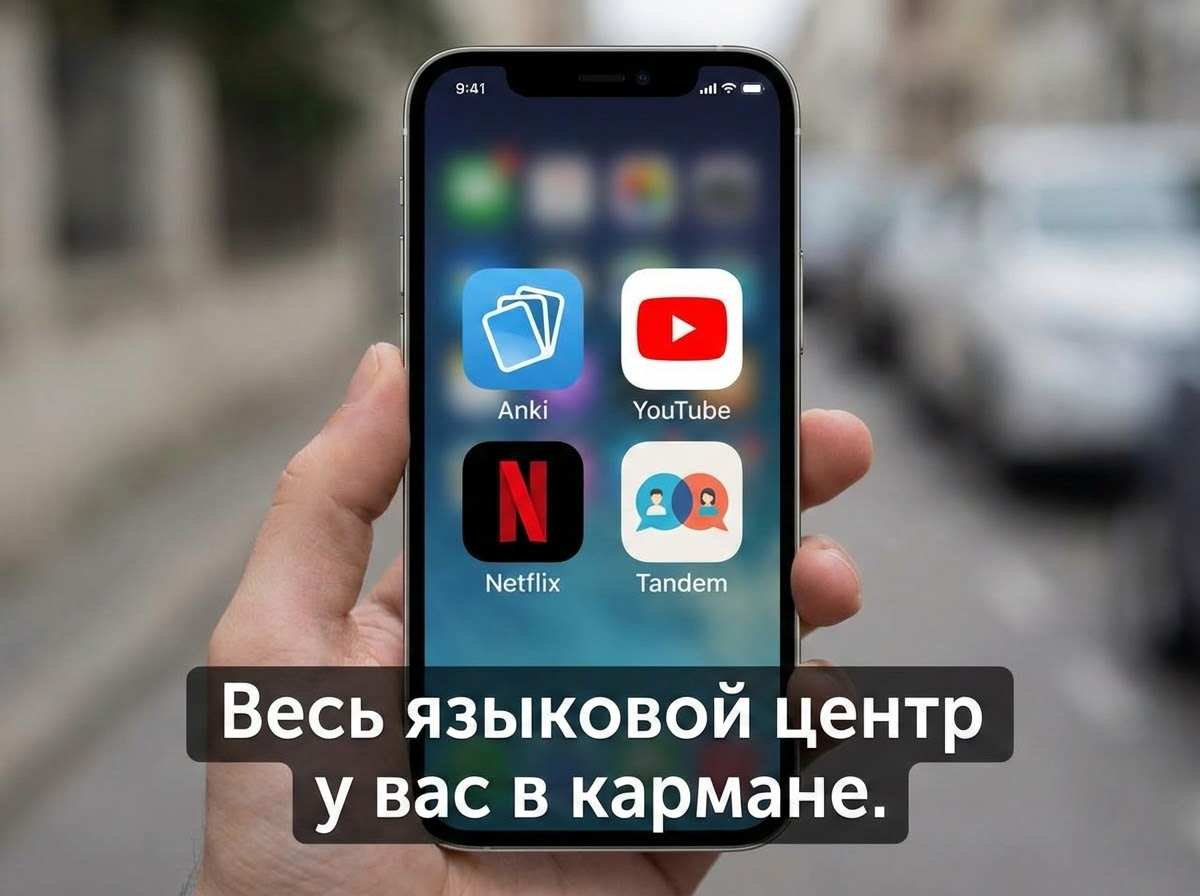
For introverts: Anki (flashcards), ChatGPT (uninhibited conversations), reading adaptive books.
-
For extroverts: Tandem (language exchange), iTalki (lessons with native speakers), conversation clubs.
Part V. Roadmap: Your First 3 Months
To stay motivated, we recommend following a simple plan.
Month 1: Habit and Base
-
Goal: To overcome fear and integrate language into routine.
-
Action: 15 minutes a day in the app (Duolingo/Anki) + 1 lesson with ChatGPT.
-
Focus: Vocabulary only. Ignore grammar for now.
Month 2: Immersion
-
Goal: To begin to understand by ear.
-
Action: Change the language on your phone. Start watching your favorite TV series with subtitles.
-
Focus: Listening. Listen, even if you only understand 30%.
Month 3: Speech Activation
-
Goal: To start speaking (even with mistakes).
-
Action: Find a Tandem partner or join a conversation club.
-
Focus: Overcoming the barrier. The main thing is to convey the idea.
Workshop: How to speak English without a tutor?
Most people drop out of school not because of laziness, but because of a lack of a system. We analyzed the experiences of over 500 "autodidacts" (those who learned a language on their own) and compiled them into an interactive guide: Self-Study Roadmap 2026 .
You don’t need to buy courses to get started. You just need the right algorithm.
Free Self-Study Guide
FAQ: Answers to Frequently Asked Questions
How long does it really take to learn English? According to Cambridge English, reaching a confident B2 (Upper Intermediate) level from scratch requires approximately 500–600 hours of guided study.
With 30 minutes of daily practice, this will take about 2-3 years; with an intensive approach, the time frame is reduced.
Is it better to start with grammar or conversation? We recommend starting with building a basic vocabulary (input). Grammar should be introduced later, as a tool for connecting words, not as an end in itself. Remember how children learn: first words, then rules.
Conclusion: Your Next Step
English isn’t just a line on a resume. It’s freedom of choice: where to live, who to work with, and what information to consume. It’s an asset that stays with you forever, regardless of exchange rates or economic crises.
You might feel like starting now is too difficult or too late. But remember: time will pass anyway. A year from now, you might be in the same place, or you might be freely discussing your ideas with colleagues from all over the world. Just take the first small step today.
Want to learn English but don’t want to spend money on courses and tutors? Try our free guide to self-studying English — get started! It’ll help you get started on your journey to language fluency.
List of sources
Paylab & Rosstat Data (2024-2025): IT Salaries Russia - [Web Finding 1] Fortune Europe / Arc.dev: Remote Software Engineer Salaries - [Web Finding 2]IRS Foreign Earned Income Exclusion (FEIE) 2026 Limits - [Web Finding 7]
DTS Translates: Impact of Translation Delays in Pharma - [Web Finding 3]-
European Geriatric Medicine: Bilingualism and Alzheimer’s Meta-analysis — [Web Finding 4]
- ERIC/Cambridge Journals: Psychology of Learning & Vocabulary Retrieval - [Web Finding 8]
Cambridge English: Guided Learning Hours (GLH) for B2 First - [Web Finding 5]
-
You cannot comment Why?