How to Learn English as an Adult (Guide):
A System for Busy People  Automatic translate
Learning a language after 25 is like training for a marathon when you already have a job, a mortgage, and chronic sleep deprivation. The two biggest weights on an adult’s shoulders are a critical lack of time and an irrational fear of looking stupid.
Author : Skyeng Methodological Team
Difficulty : For beginners and advanced learners
School methods ("open the textbook, translate the text") don’t work here. They’re designed for kids with tons of time and no choice. You need a different approach — an engineering one, based on the laws of neuroscience and strict time management. In this guide, we’ll cut through the fluff and provide a working framework.
Take a look at the image below. If this describes you, you’ve come to the right place.

2 Strategy: Roadmap for the first 4 weeks
3 Tactics: Schedule for the Busy (How to Find Time You Don’t Have)
4 Choosing a Format: On Your Own vs. With a Trainer
5 4 Pillars of Language: Developing Skills Comprehensively
6 Arsenal of Tools: What to Download and Not Delete
7 Anti-crisis block: Plateau and Burnout
8 Conclusion: The First Step Rule
Can an adult learn English? (Spoiler: Yes, just update your firmware)
Forget the "train has left the station" myth. Neuroscience proves the opposite: the brain is plastic until old age. Yes, children absorb information like a sponge, but they do so chaotically and unconsciously.
Adults have an advantage that children lack: developed logic and discipline. The adult brain is a powerful server with an advanced operating system. We can build cause-and-effect relationships and control processes. We won’t imitate children; we’ll leverage the advantages of adult thinking.
Here’s how your "architecture" differs from that of a child:
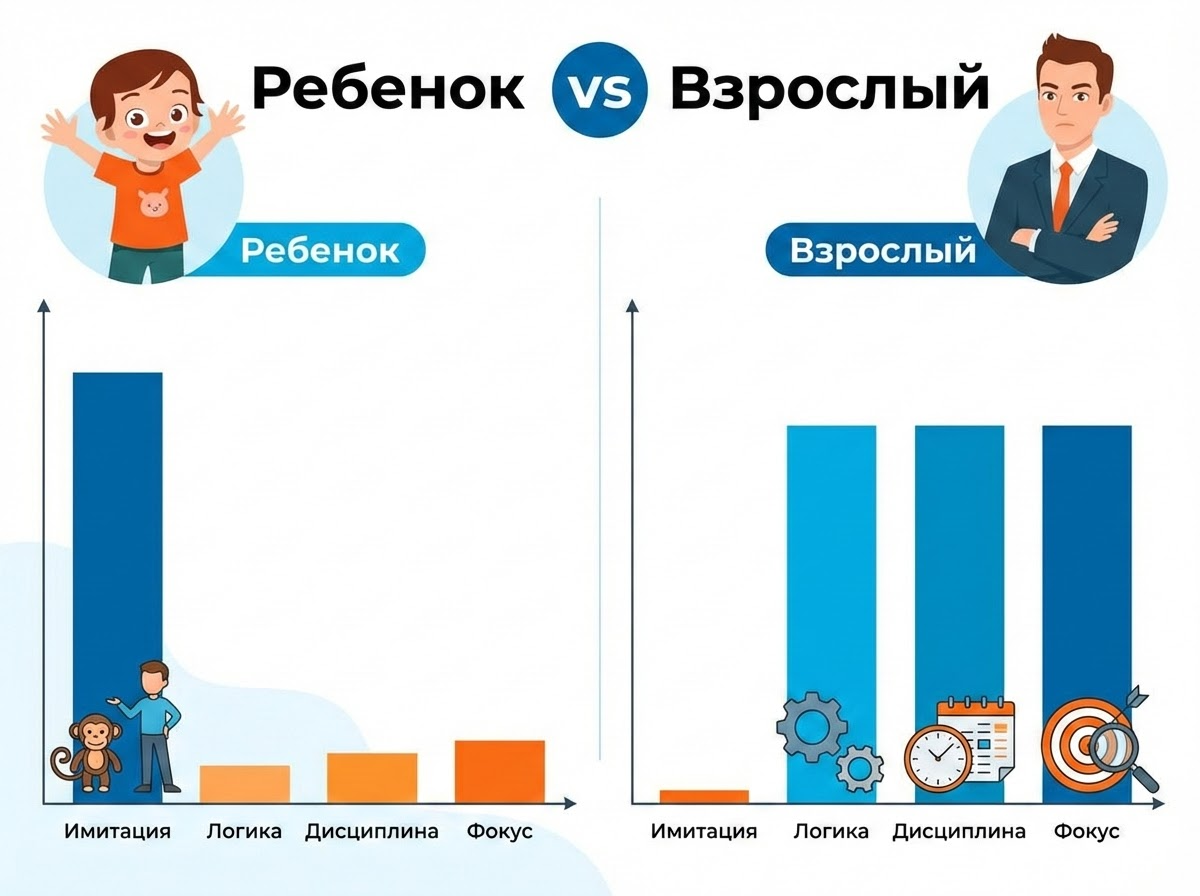
Caption: Adults learn differently, but no worse. Use logic as leverage.
3 Main Myths That Are Stealing Your Time
- The myth of talent. "I have no talent for languages." This is a lie. Language is not an art; it’s a mechanical skill, like driving a car. Global EF EPI statistics show that the average language proficiency level worldwide is B1 (502 points). In countries with a systematic approach (the Netherlands, Singapore), the average level is 640+ points. It’s not about genes, but about methodology.
- The myth of the environment. "I’ll go to London and start talking." You won’t start talking if you remain silent. An artificial linguistic environment at home (phone interface, podcasts in the car) is often more effective than passive living abroad.
- The age myth. There is a critical period, but it only affects accent. Grammar and vocabulary can be mastered at a native level even at 80.
Strategy: Roadmap for the first 4 weeks
Without a plan, you’ll be downloading apps haphazardly and abandoning them after a week. We’ve prepared a structured start to ensure you stay on track.
Week 1: Diagnostics and Base
- Task : Determine point A and set up the environment.
- Step 1 : Take a language level test (don’t rely on your feelings).
- Step 2 : Set a SMART goal. Bad: "I want to know English." Good: "Get an interview at an IT company in 6 months."
- Step 3 : Switch your phone to English. This is the first step to immersion.
Week 2: Connecting the Voice
- Task : Overcome the fear of the sound of your voice.
- Action : Begin the "Shadow Replay" technique (more on that below). 5 minutes a day.
- Tool : Duolingo or similar for creating a habit (dopamine loop).
Week 3: Context and First Dialogues
- Task : Get out of your comfort zone.
- Action : First session with a teacher or a trip to a conversation club.
- Focus : Not on grammar, but on being understood.
Week 4: Rhythm and Reinforcement
- Task : Stabilization of the schedule.
- Action : Evaluate your progress. If you miss a class, don’t beat yourself up; simply adjust your plan. Introduce writing practice (3 sentences per day).
Assess your capabilities realistically. The table below is your timeline:
The math is simple: advancing from one level to the next (for example, from A1 to A2) requires 100-150 hours of quality study. To go from zero to a confident B1, expect to invest 350-400 hours .
Tactics: Schedule for the Busy (How to Find Time You Don’t Have)
The biggest mistake is trying to study for two hours twice a week. It doesn’t work. Effective language learning is based on frequency, not duration.
Scenario A: "Sprinter" (15-20 minutes per day)
Ideal for busy schedules.
- Morning (5 min) : While the coffee is brewing, repeat 10 words in the app (Anki/Skyeng).
- Road (10 min) : Listen to a podcast or audio lesson.
- Evening (5 min) : Write 3 sentences about your day in your notes.
Scenario B: "Hybrid" (Weekdays + Weekends)
A balanced approach.
- Weekdays : 15 minutes of micro-practices (words, short videos).
- Day off : 1 hour of full-time tutoring or deep dive (TV series with analysis).
Choosing a Format: On Your Own vs. With a Trainer
It’s like going to the gym: you can work out on your own using YouTube videos, or you can work out with a trainer who will teach you technique and prevent you from slacking off.
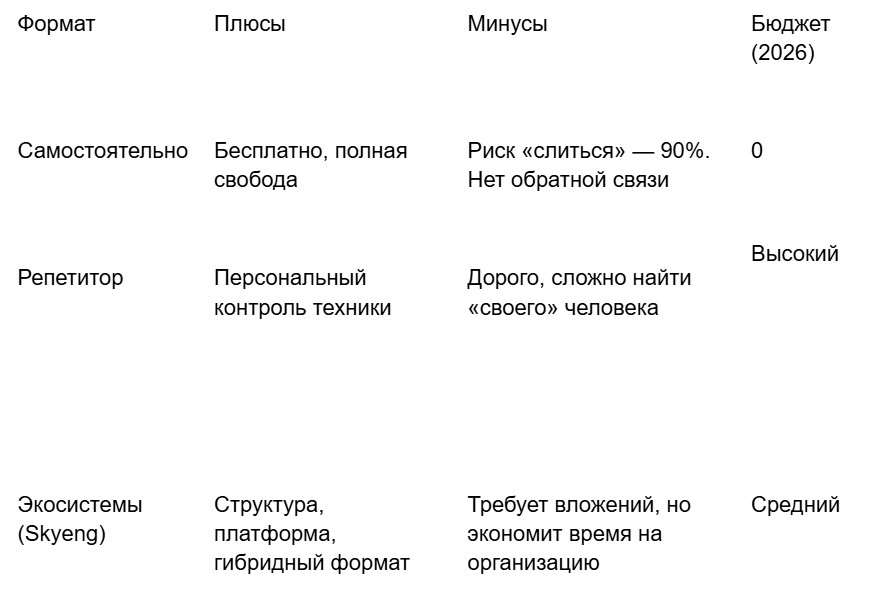
Our experience: If you value your time, choose a hybrid format — lessons with a teacher for monitoring plus independent work on the platform. This is how modern English courses are structured , where routine tasks (word checking, grammar) are handled by an algorithm, while real-life practice is handled by a human.
4 Pillars of Language: Developing Skills Comprehensively
Language rests on four pillars: Listening, Speaking, Reading, and Writing. If you focus solely on reading, you’ll be like an athlete with an over-developed right arm. Balance is essential.
Input must be converted into output. Close the loop:
1. Listening: How to stop hearing "mush"
Your ears need to calibrate to the frequencies of the new language.
- Method : Active listening. Not just background noise, but an attempt to isolate specific words.
- Lifehack : Turn on English subtitles. Russian text is a dead end to progress — the brain is lazy, it just reads native letters and turns off its hearing.
2. Reading and Vocabulary: Learn Words Without Rote Memorization
Memorizing lists is so last century. The brain only remembers things that are emotionally charged or frequently repeated.
- Tool : Spaced Repetition.
- Algorithm : Repeat the word after 1 day, 3 days, a week, and a month. This will move it from "RAM" to "hard drive."
3. Writing: The Power Framework of Speech
This skill is often overlooked, but in vain. Writing is like speaking in slow motion. It allows you to formulate your thoughts without stress or rush.
- Practice : Keep a micro-diary. Just 2-3 phrases a day: "Today was hard. I drank too much coffee."
- Assistant : Use Grammarly or AI assistants to check yourself, but write it yourself.
4. Speaking and the "Dog Effect"
The "dog effect" is a classic condition: I understand everything, my eyes are intelligent, but I can’t speak. This can only be cured by articulation practice. Your speech muscles are simply not accustomed to the new movements.
Here’s what a safe workout looks like:
VISUAL (real): A photograph of a person wearing headphones, talking to themselves in front of a mirror or while walking (shadowing technique). The atmosphere is relaxed.
Caption: Shadowing Technique: Speak at the same time as the announcer to get used to the sound of your voice.
Shadowing Technique:
- Play audio (podcast).
- Repeat after the speaker out loud with a half-second delay.
- Copy the intonation, emotions, and pauses. After a month of this "shadow wrestling," your accent will become clearer, and your sentences will start to flow automatically.
Arsenal of Tools: What to Download and Not Delete
The market is flooded with apps. The main pitfall is "app-hopping." Research confirms that searching for the "perfect" app creates the illusion of productivity but leads to burnout . Choose one set for specific tasks:
- For habit : Duolingo (gamification).
- For words : Anki / Memrise (spaced repetition).
- For context : Taalhammer / Langua (next-generation AI tools) .
- For checking : Grammarly (digital editor).
- For immersion : YouTube (live language).
Anti-crisis block: Plateau and Burnout
What should you do if progress has stalled (plateau)? A plateau usually occurs at the Intermediate level. This is normal: the brain has adapted to the workload.
- Solution : Change your workload. Reading textbooks? Start reading the news. Watching TV series? Try translating an article on your profession. The brain needs new stress to grow.
What should you do if you’ve neglected your habits for a month? The key is to avoid trying to make up for lost time in one day. That’s a surefire way to relapse.
- Maintenance Mode : This week, practice for only 5 minutes a day. Your goal isn’t to learn anything new, but simply to get back into the habit of opening an app or notebook.
How much time does it really take? According to FSI (Foreign Service Institute), level B2 requires 600–750 hours
. At a pace of 1 hour per day, that’s about 1.5–2 years. If you want to progress faster, increase the intensity of your studies, not their duration.
Conclusion: The First Step Rule
Language learning is the cumulative effect of micro-actions. Don’t wait for a "perfect Monday." The best time to plant a tree was 20 years ago. The second best time is now.
Don’t set a goal of "learn English." Set a goal of "take a 15-minute lesson today" or "learn 5 words." Small victories create great motivation.
Action: Take a language level test or download one app from the list right now. Take the first step.
List of sources
EF EPI 2023/2025 Global Scores & Rankings - [Ref-1] Cambridge English: Guided Learning Hours - [Ref-2] Tutor Rates Analysis - [Ref-3] Language Learning Burnout & Motivation 2025 - [Ref-5] Best AI Language Apps Reviews - [Ref-6]
FSI Language Difficulty Ranking & Hours - [Ref-4]
- Developing a Successful Blogging Strategy for Tech Companies
- Top 5 Tips for Learning Chinese from Scratch: Characters, Tones, and HSK Preparation
- Exhibition "Actual Udmurtia" in Moscow
- Exhibition of Israeli sculptor Inna Nikolaeva "HEARING WIND"
- Using Online Surveys in Marketing
- Music Concert Yu Maro
You cannot comment Why?