How to Become a Graphic Designer from Scratch:
Plans, Salaries, and Software  Automatic translate
How to Become a Graphic Designer from Scratch: A Honest Plan, Salaries, and Pitfalls.
Visual communication is the fuel of modern business. As you read this, thousands of companies are searching for a specialist who can transform their ideas into understandable images. But let’s take off our rose-colored glasses right away: design isn’t magic or pure creativity. It’s technology.
Today we’ll break down the mechanics of the profession without the marketing fluff:
- Reality : What a designer actually does (spoiler: they don’t draw).
- Route : Step-by-step action map for the first 6 months.
- Money : How much they pay in Russia and abroad (adjusted for 2026).
- Tools : Which software to learn and which is a waste of time.
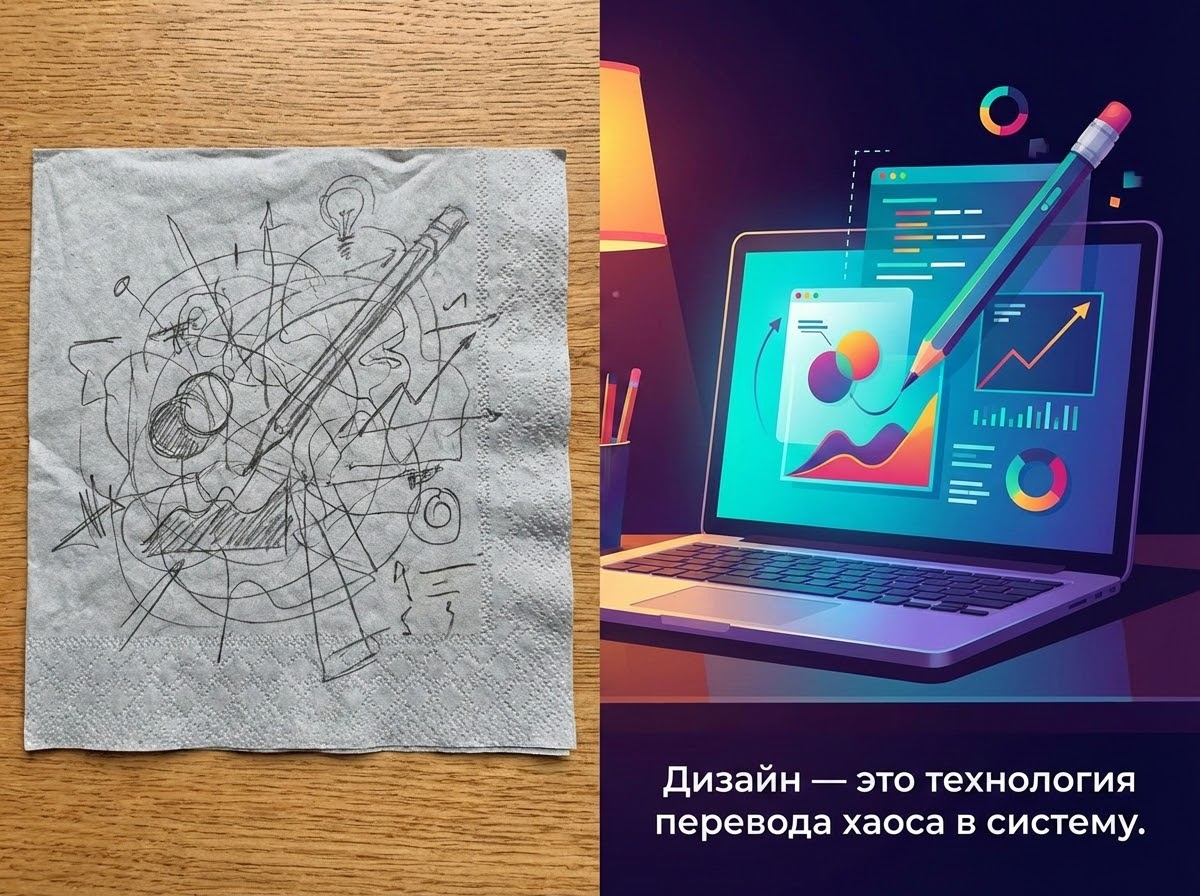
The following illustration clearly shows how chaos turns into order in the hands of a professional:
2 Real Roadmap: Route to 2026
3 The most profitable niches of 2026
4 Education: University, Courses, or Self-Study? (Calculating ROI)
5 AI in Design: Friend or Killer of the Profession?
6 Career and Money: Real Figures (Russia vs. World)
7 How to Find Your First Order: The Hunter’s Strategy
8 Take the first step
Who is a graphic designer (and why is "art" unnecessary)
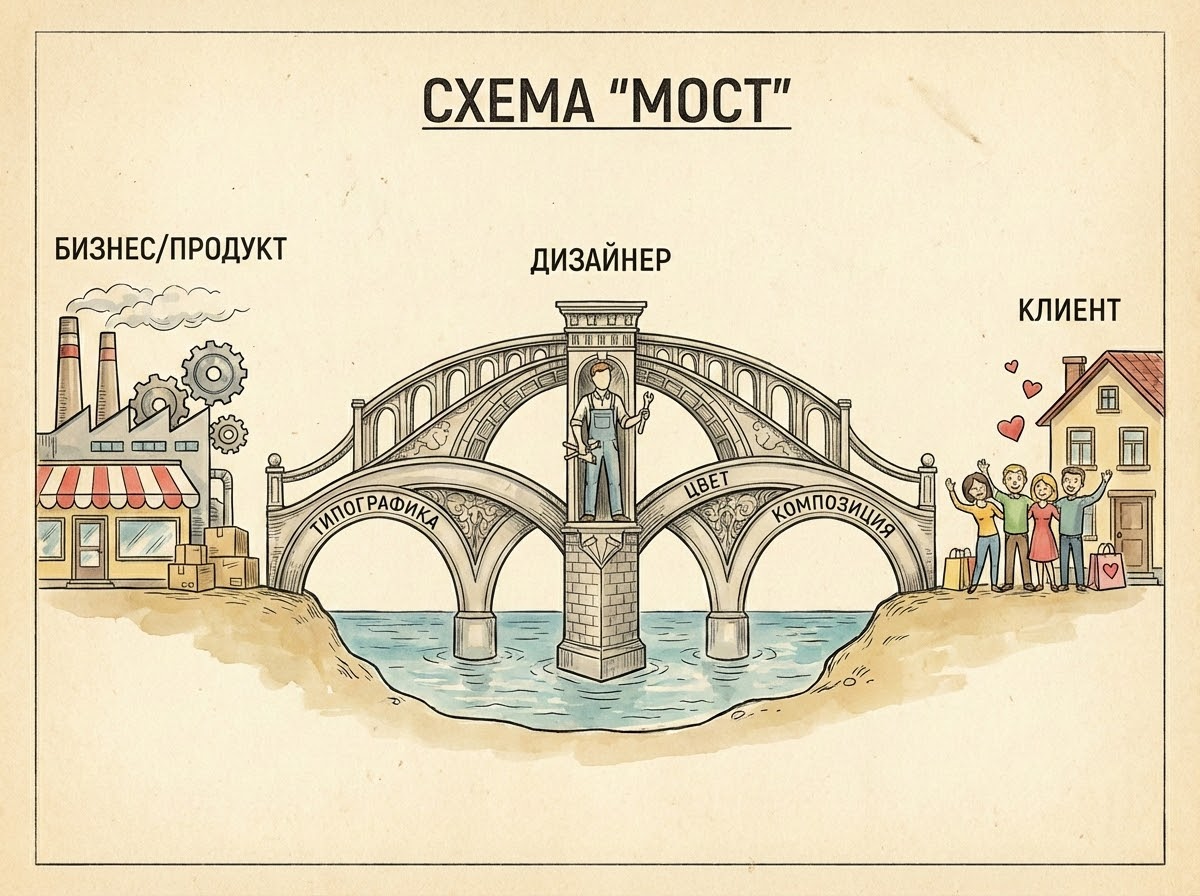
A graphic designer is a visual communications engineer. Your job isn’t to create paintings for the Louvre, but to solve specific business problems: sell a product, simplify instructions, and increase brand awareness. You translate the dry language of business into the language of human emotion.
In practice, there’s a common misconception: "To be a designer, you need to be able to draw." This is a myth. Modern design is built on grids, composition, mathematical logic, and the psychology of perception. Being able to draw is a nice bonus, like being able to play the guitar for a programmer: it’s cool in the company, but it won’t improve your code (or layout).
Take a look at the diagram below. It shows your actual place in the business food chain:
Workdays: What will you be doing?
Forget the romantic image of a creator awaiting a muse. Your workday is a conveyor belt of decisions:
- Briefing (Analysis) : We figure out what we’re selling, to whom, and why. Without this step, the work goes to waste.
- Research : Analysis of competitors and search for visual references.
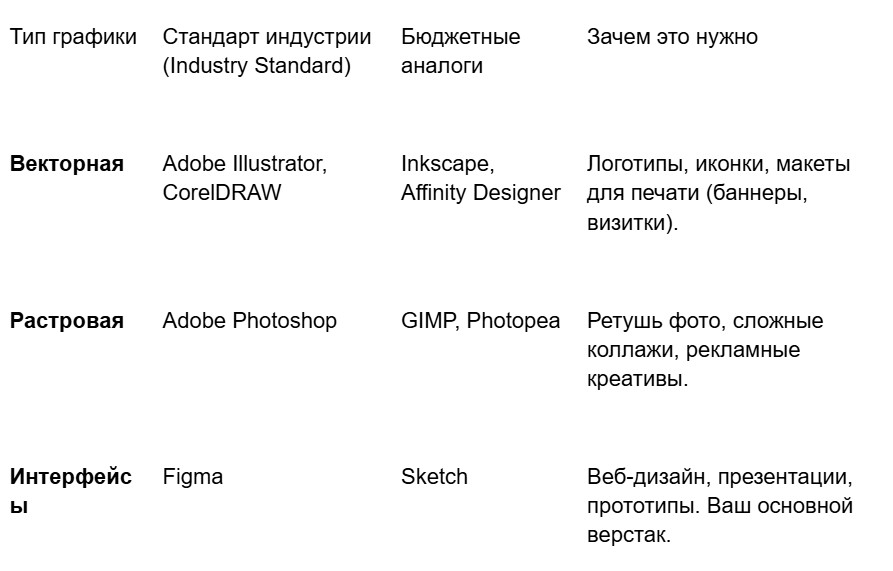
- Assembling the model : Working in graphic editors (Figma, Photoshop). This is your construction site.
- Edits : The client will always make adjustments. This is part of the production process, not a personal insult.
- Pre-press (Preparation) : Technical adaptation of files for printing or layout on a website.
Real Roadmap: Route to 2026
Entering a profession is a marathon, not a sprint. To avoid burning out halfway through, you need a clear training plan. Randomly consuming YouTube videos will create the illusion of knowledge, but it won’t give you the skills.
Below is your route:
Step 1: Foundation (Composition, Color, Typography)
Trying to design without knowing the basics is like building a house without a foundation: the first wind (or the client’s edit) will destroy everything. You need to master three pillars:
- Composition : Directing the viewer’s attention. Rule of thirds, visual weight, rhythm.
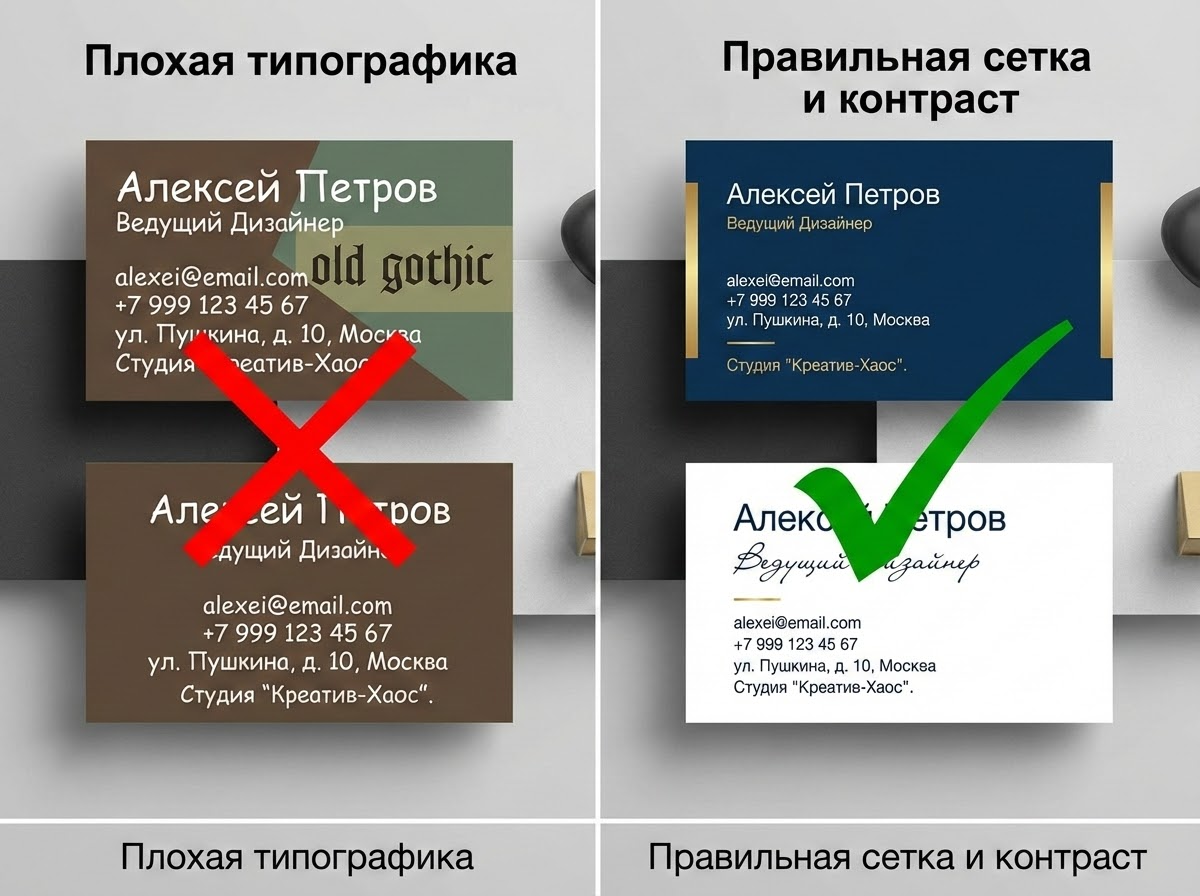
- Typography : Fonts are the voice of a layout. You’ll learn how to build hierarchy so text is readable, not guessed.
- Coloristics : The Psychology of Color. You’ll learn why a bank can’t be frivolous pink, or fast food a cool blue.
The difference between “design” and “just a picture” is colossal and measurable:
Step 2: Arsenal of Tools (Software Table)
Tools are your hammer and chisel. Don’t worship them, just learn to wield them confidently.
Step 3: Training your visual acuity (Where to get taste)
Taste is a muscle. It can and should be exercised. Visual acuity is your visual library, which your brain accesses when solving problems. Where to train daily:
- Behance : Study the cases in their entirety and look at the narrative logic.
- Dribbble : For quick visual shots (UI/UX).
- Pinterest : Collect mood boards, analyze styles.
- Awwwards : "High Fashion" of web design.
Practical Checklist: Your First 6 Months
To avoid getting stuck in theory, follow this chart:
- Month 1 : Mastering Figma and Photoshop (basic level). Studying color theory and composition. Copying good (pixel-perfect) work to understand the mechanics.
- Month 2 : Creation of the first 3 educational projects (business card, banner, landing page).
- Month 3 : Packaging cases on Behance. Registering on freelance exchanges.
- Month 4-5 : Active search for first orders, networking, completing test assignments.
- Month 6 : First commercial money, analysis of mistakes, choosing a narrow niche.
The most profitable niches of 2026
Don’t try to be a specialist in everything. The money lies where narrow expertise intersects with business pain points. The 2026 market highlights the following areas:
:
- Web Design : Websites and apps are needed by everyone, from coffee shops to factories. The most mass-market.
- Motion Graphics : Static images are a thing of the past. Animation for social media captures attention, and attention is the new currency.
- Packaging Design : Packaging sells a product on the shelf. It’s critically in demand in retail and e-commerce.
- Presentation Design : Businesses need to package reports and pitches for investors. They pay for logic and clarity.
Education: University, Courses, or Self-Study? (Calculating ROI)
Investment in training should pay off. Let’s calculate the ROI (return on investment) for different trajectories:
Debriefing:
- University : Long and expensive. Four to six years and $7,260 to $27,900 per year (compared to Western universities). There are few state-funded places in Russia. You’ll gain a strong foundation in art history, but risk graduating with outdated software knowledge.
- Online courses : The perfect balance. You get structured information and, more importantly, mentoring (feedback). The price of a professional program ranges from $975 to $12,844 (globally), with lower and more affordable prices in Russia . This is the path for those who value their time.
- Self-education : Free, but chaotic. You’ll spend hundreds of hours filtering out the "infonoise." Suitable only for those with iron self-discipline, willing to learn from their own mistakes, not from those of others.
Want to master a sought-after IT profession with a guaranteed job?
If you’re worried about your current skills becoming obsolete and your salary remaining stagnant while others are successfully advancing in IT, consider Skypro’s data analytics courses. We offer highly practical training tailored to real businesses’ needs, with a legally binding employment or money-back guarantee. Skypro holds a state license for educational activities (No. L035-01298-77/00181469) issued by the Moscow Department of Education and Science, confirming the quality and reliability of our education.
Learn more about Data Analytics courses
AI in Design: Friend or Killer of the Profession?
Let’s be honest: neural networks won’t take your job. A designer who knows how to use neural networks will. In 2026, AI is a powerful exoskeleton that amplifies your capabilities.
How it works in practice:
- Midjourney : Generate ideas and mood boards in seconds.
- Photoshop AI : Routine retouching and background removal with one button.
- LLM (ChatGPT/Claude) : Writing "fishy" text for layouts.
Technology does not replace creativity, it removes routine:
Career and Money: Real Figures (Russia vs. World)
Money doesn’t fall from the sky; it’s paid for the value you bring to the business. Income is directly dependent on your grade (skill level).
Dry numbers (Relevance: 2025-2026):
- Junior (Beginner, experience < 1 year) :
- RF : There won’t be mountains of gold at the start. Expect to earn 40,000–70,000 rubles per month. This is the time you’ll need to work to earn your credit.
- Global : Remote work for Western startups can earn up to $15-20/hour, but competition is high.
- Middle (1-3 years of experience) :
- RF : You are an independent combat unit. The median salary is approximately 100,000–150,000 RUB/month.
- Global : The annual income of a stable middle is $45,000 – $65,000.
- Senior (Pro, 3+ years of experience) :
- RF : From 180,000 RUB/month and up, ceiling depends on niche
-
.
- Global : Seniors at top companies earn $85,000+ per year.
- RF : From 180,000 RUB/month and up, ceiling depends on niche
The Business Side of Freelancing (What They Don’t Tell You in Courses)
Freelancing is a small business. In Russia, you’ll need to figure out how to become a self-employed individual or sole proprietor to sleep soundly.
- A contract is your shield. Working without paper is charity.
- Prepayment is the law. Always take 30-50% upfront. This filters out frivolous clients.
- Communication. Being able to explain to the client why this solution will make them money is more important than knowing hotkeys.
How to Find Your First Order: The Hunter’s Strategy
Sitting by and waiting for the weather to change is a failing strategy. Take aggressive action:
- "Fake" cases : No clients? Invent them. Rebrand your favorite coffee shop near your home. Package it in a case: Problem -> Solution -> Result. Employers care about your thought process, not the stamp on your contract.
- Exchanges (Kwork, Upwork) : A great place to learn and get your first feedback. Upwork requires B1+ English.
- Telegram channels : Monitor job openings and internships. Write personalized responses, not copy-pasta.
- Networking : Tell all your friends and social media that you’re now a designer. Word of mouth brings in the most loyal first clients.
Take the first step
Learning design is like exercising: you can watch workout videos, buy fancy gear, and read forums all day long, but it won’t build muscle. The only way to get started is to start.
Right now is the best time to start. Download Figma (it’s free), open a blank frame, and draw your first rectangle. You’re already closer to your goal than 90% of dreamers.
List of sources
College Tuition Compare: Graphic Design - https://www.collegetuitioncompare.com/career/graphic-design/ Noble Desktop: Cost to Learn Graphic Design - https://www.nobledesktop.com/learn/graphic-design/cost-to-learnPaylab: Junior Graphic Designer Salary - https://www.paylab.com/ru/salaryinfo/journalism-printing-arts-media/junior-graphic-designer?lang=en
PayScale: Graphic Designer Salary RU - https://www.payscale.com/research/RU/Job=Graphic_Designer/SalaryPlane.com: Salaries Russia - https://plane.com/salaries/graphic-designer/russia
Levels.fyi: Graphic Designer Moscow - https://www.levels.fyi/t/graphic-designer/locations/moscow-rus-
ExDesigner: Salaries Moscow Oblast - https://exdesigner.net/salaries/russia/moscow-oblast
- RTINGS: Monitor Color Gamut Tests - https://www.rtings.com/monitor/tests/picture-quality/color-gamut
Upwork: Graphic Design Niches - https://www.upwork.com/resources/graphic-design-niches"
- Doing business in the USA in questions and answers
- Major international sporting events
- From Theory to Practice: Scrum Methodology and How Scrum Works
- In-person preparation for the Unified State Exam: Why travel to classes when you have internet access?
- 4 Kitchen Wall Decor Ideas to Refresh Your Kitchen
- Not Just Decor: 20 Unexpected Ways to Use Gold Leaf
You cannot comment Why?